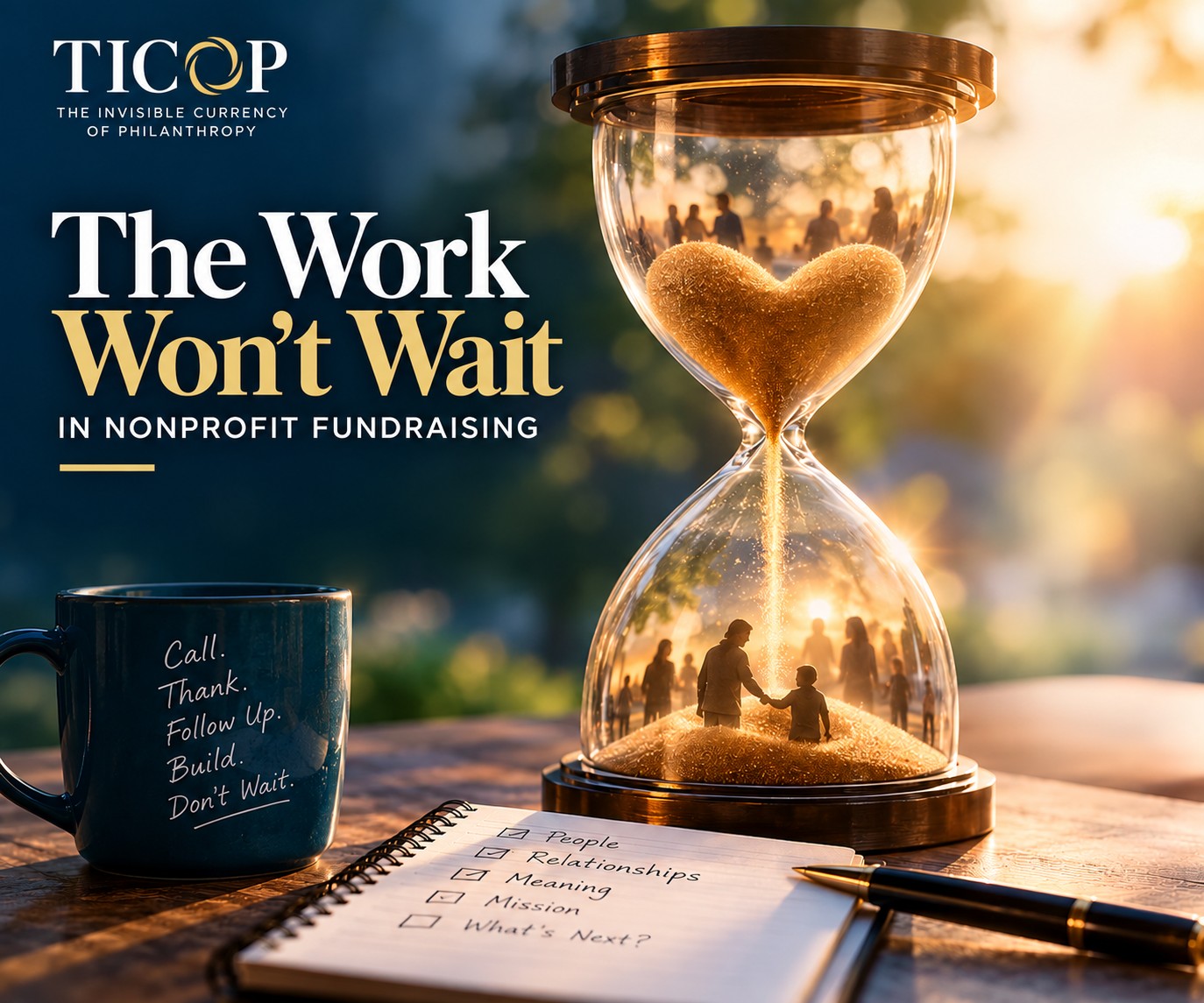
There is a phrase I have heard in nonprofit organizations more times than I can count:
“We’ll get to that after the event.”
“We’ll follow up with those donors next month.”
Or my personal favorite:
“Let’s circle back after things slow down.”
If you have worked in a nonprofit for longer than about 17 minutes, you already know the problem.
Things do not slow down.
There is always another grant deadline, another board meeting, another event, another spreadsheet somebody suddenly needs by 3:00, and another donor who decides Friday at 4:47 is the perfect time to discuss their estate plan.
Welcome to nonprofit fundraising.
But here is what I have learned after years in advancement:
The mission may be patient. Relationships are not.
Too many organizations treat fundraising work like administrative work—something that can be pushed three weeks down the calendar without consequence.
The thank-you call can wait.
The coffee can wait.
The first-time donor can wait.
The board member who offered an introduction can wait.
Except sometimes they don’t.
Sometimes they move on.
Sometimes another organization invites them into a meaningful relationship while we are still deciding who should enter their name into the CRM.
That is why the work won’t wait.
Not because fundraisers should constantly operate with their hair on fire. We have enough of that already.
It is because human connection has a shelf life.
Generosity Is Strong. Attention Is Fragile.
Americans gave an estimated $617.2 billion to charity in 2025—the first time annual charitable giving crossed $600 billion.
Yet underneath that generosity is an important warning.
The Fundraising Effectiveness Project reported that fundraising dollars grew in 2025 while the number of donors declined. Donor retention remained below half.
Americans gave an estimated $617.2 billion to charity in 2025 — a historic milestone. Yet donor retention remained below 50%, meaning more money from fewer people. The relationships behind the numbers are thinning.
More money. Fewer donors.
That should get our attention.
A few larger gifts can make a dashboard look terrific while hundreds of relationships quietly disappear. There is no neat line on the income statement labeled:
Donors who still love us but haven’t heard from us in nine months.
There probably should be.
The First Gift Is Not the Finish Line
One of the biggest mistakes in fundraising is treating the gift like the conclusion of the relationship.
A donor gives.
We celebrate.
Finance records the gift.
The receipt goes out.
Then everybody goes looking for the next donor.
Meanwhile, the person who just raised their hand and said, “I believe in this,” is sitting right there.
This is why I say: the first gift is not the answer. It is a question.
The donor is asking:
Was this meaningful?
Can I trust you?
Do I belong here?
Will you remember me when you don’t need money?
Did my contribution actually matter?
Those questions sit at the heart of what I call the Invisible Currencies of Philanthropy: Belonging. Trust. Meaning. Emotional Return. Transformation.
Money may begin the transaction. Those currencies determine whether the relationship continues.
Donor Emotion Has a Window
When someone attends your event and gets emotional hearing a story, there is a window.
When someone volunteers for the first time and says, “This was incredible,” there is a window.
When someone makes their first gift, there is a window.
When a business leader says, “I’d love to learn more,” there is a window.
These are moments of maximum emotional temperature. And too many organizations let them cool.
Three weeks later we send the email.
Two months later we schedule the tour.
Four months later somebody finds the business card.
By then, we are trying to restart an emotional experience instead of continuing one.
You should never confuse someone’s generosity with their permanent attention.
People are busy. Their lives are full. Fundraising does not happen in a vacuum. Stewardship is sometimes treated like the vegetables on the fundraising plate—everybody knows it is important, and somehow it still gets pushed to the side.
But stewardship is not an accessory to fundraising. Stewardship is fundraising. Maybe the purest form of it.
Because stewardship asks: How do we create value for someone when we are not asking them for anything? That is where trust grows.
Every meaningful update is a deposit.
Every promise kept is a deposit.
Every time a donor feels known rather than processed is a deposit.
Every time someone hears from us only when we need money? Withdrawal.
The invisible currency is always moving.
Create a Relationship Clock
One simple practice can change your fundraising culture. Start measuring relationships not only by deadlines, but by relationship clocks.
When someone gives for the first time, the clock starts.
When someone attends an event, the clock starts.
When someone offers an introduction, the clock starts.
When a longtime donor disappears, another clock starts.
Ask: What meaningful human action should happen next, and how quickly should it happen?
Maybe it is a call. A handwritten note. A coffee invitation. A quick video from someone impacted by the mission. Maybe it is simply: “I was thinking about what you said when we met last week.”
Those words communicate something every human being wants to know: You were remembered.
That is belonging. That is emotional return. That is invisible currency.
Stop Waiting for the Perfect Reason to Call
Fundraisers sometimes make donor relationships far more complicated than they need to be. We think every interaction needs an agenda, a strategy, a portfolio objective and a measurable next step.
Sometimes you can just call people.
“Hi Susan. I was thinking about you and wanted to tell you something that happened here this week because I thought you’d appreciate it.”
That’s fundraising. Not because you asked for money. Because you strengthened meaning.
We have become so sophisticated about moves management that sometimes we forget people management is mostly about being a decent human being.
Do the Human Work First
There will always be another spreadsheet. Another campaign. Another event. Another meeting where someone says, “We really need to engage our donors more.”
Agreed. Start today.
✓ Call five donors.
✓ Thank three volunteers.
✓ Reach back out to the person who stayed after your event asking questions.
✓ Check on the longtime supporter you haven’t seen lately.
✓ Tell someone what happened because they said yes.
Because in fundraising, silence is not neutral.
Distance grows.
Attention moves.
Emotion cools.
Trust weakens.
Belonging fades.
The work won’t wait. And more importantly, the relationship shouldn’t have to.
You do not build extraordinary donor relationships someday. You build them in the small window between someone caring and someone wondering whether you noticed.
Don’t miss the window. The gift may arrive in a moment. The relationship is built in what you do next.