There is a moment that happens in nonprofit organizations all over the country.
The revenue numbers come in. They aren’t where leadership hoped they’d be. Someone looks around the conference table and says some version of:
“We need more donors.”
Maybe.
But maybe not.
Sometimes you don’t need more donors. Sometimes you need to understand why the donors you already have aren’t moving closer. Sometimes you don’t have a fundraising problem.
You have a relationship problem.
A trust problem.
A communication problem.
A belonging problem.
A meaning problem.
And hiring another development officer, adding another gala, sending another email blast, or buying another database won’t necessarily fix any of those things.
I’ve spent enough years around fundraising, marketing, development, boards, campaigns, events, donors, sponsors, and nonprofit leaders to know something that isn’t always comfortable to say:
Fundraising problems are often symptoms. The real issue lives underneath the money.
The Spreadsheet Can Tell You What Happened. It Can’t Always Tell You Why.
We love dashboards in advancement. Total dollars raised. Donor retention. Average gift. Number of donors. Major-gift pipeline. Event revenue. Email open rates. They’re important.
But here’s the problem.
A spreadsheet can tell you that Susan gave $5,000 last year and nothing this year. It can’t tell you that Susan stopped feeling connected to your organization.
Your CRM can tell you Robert hasn’t responded to your last three appeals. It can’t tell you that Robert started wondering whether anybody knew him beyond his donor ID.
Your dashboard can tell you that annual giving has flattened. It can’t necessarily tell you that your donors hear from you constantly when you need something and rarely when you don’t.
That’s where fundraising gets interesting. Because philanthropy isn’t just an exchange of money. It is an exchange of meaning. And that is what I call The Invisible Currency of Philanthropy.
There Are Currencies Being Exchanged Before a Dollar Ever Changes Hands
When someone chooses to support an organization, several things may be happening beneath the transaction. They may be saying:
I believe in this.
I belong here.
I trust you.
This matters to me.
This organization reflects something I value about myself.
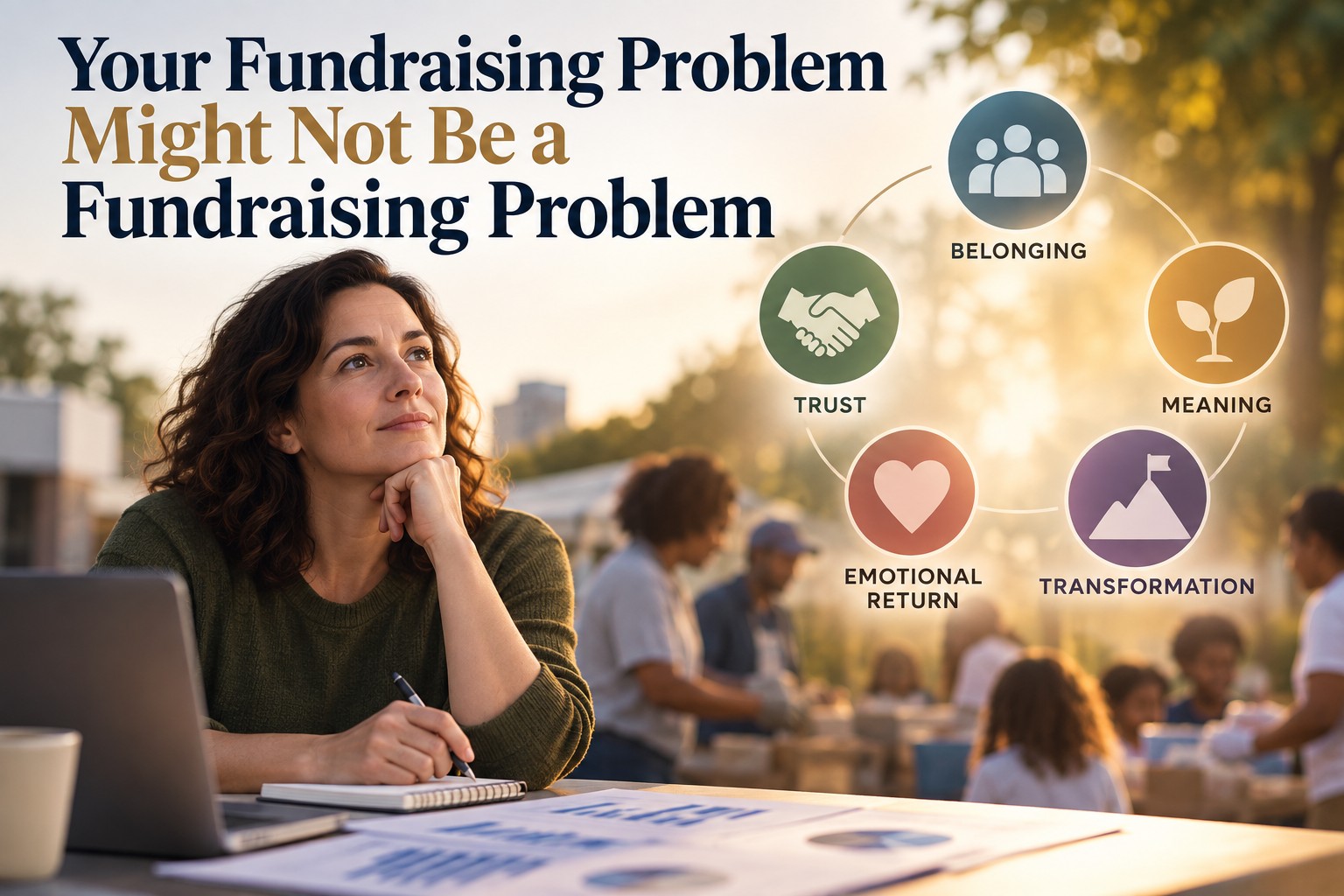
The gift is simply the visible part. The invisible part is what sustains the relationship. I describe that through five currencies:
Does your donor feel like part of the mission—or simply part of your mailing list? People want to feel that their participation matters and that they fit somewhere meaningful. A donor who feels like a stranger will eventually behave like one.
Trust is one of the most valuable assets your nonprofit owns—and it doesn’t appear on your balance sheet. Do donors believe you’ll use their resources wisely? Do you follow through? Do you tell the truth when things don’t go perfectly? Trust compounds. Unfortunately, distrust does too.
Why does this organization matter to this particular person? Two people may make identical $1,000 gifts for completely different reasons. One sees herself in the people you serve. Another remembers a parent. The amount may be the same. The meaning is not.
Donors experience philanthropy emotionally. Giving can create joy, hope, pride, connection, gratitude, healing, and purpose. The question isn’t simply “What did their gift accomplish?” It’s also: “What did their participation allow them to experience?”
The deepest philanthropy isn’t simply about what the donor helps change—it’s about who the donor becomes through participating in that change. “I am someone who helps young people succeed.” “I am someone who leaves things better than I found them.” That’s transformation. And when an organization understands these currencies, fundraising stops feeling like an endless series of transactions. It becomes relationship development.
So Maybe You Don’t Need Another Fundraiser
I’ve seen organizations respond to disappointing fundraising results by immediately assuming they have a staffing problem. Sometimes they do.
But imagine hiring a phenomenal development director and dropping that person into a system where:
The board doesn’t understand fundraising.
The CEO only engages donors when there’s an ask.
Stewardship is inconsistent.
Marketing and development barely communicate.
The database is messy.
Donor stories aren’t being captured.
Nobody has clearly segmented the donor base.
Events have become the strategy instead of part of the strategy.
And communication is almost entirely transactional.
You’ve just hired a very talented person to operate inside a broken ecosystem. Eventually leadership may say: “Fundraising isn’t working.”
No. The advancement system isn’t working. There’s a difference.
Five Questions Every Nonprofit Leadership Team Should Ask
Before you announce another event, hire another fundraiser, or launch another campaign, put these five questions on the conference room table.
Do our donors feel known?
Not thanked. Known. Do you understand why your important donors care? Do you know their connection to the mission? Do you know what impact excites them? If your relationship with a donor is mostly gift date, gift amount, and appeal history, you know their transactions. You don’t necessarily know them.
Do donors understand what happened because they participated?
One of the fastest ways to weaken a donor relationship is to continually ask people to make a difference without regularly showing them the difference they already made. Stewardship isn’t a receipt. It’s closing the emotional loop: You helped. Here’s what happened. Thank you.
Do we communicate when we aren’t asking for money?
Pull up your last ten donor communications. How many contained an ask? Now imagine having a friend who called nine times out of ten because they needed something. You’d probably start screening the calls too.
Does our board understand its role in philanthropy?
Board fundraising cannot simply mean “Give us ten names.” Your board can open doors, tell stories, make introductions, thank donors, invite people into the mission, share expertise, host conversations, build credibility. Fundraising participation is much broader than solicitation.
Is fundraising integrated into the organization—or isolated inside development?
Development cannot be an island. Programs create impact. Marketing communicates impact. Leadership builds trust. Boards create access. Development connects all of it to philanthropy. If those functions aren’t aligned, your advancement team spends half its energy trying to manufacture fundraising assets the organization should already be producing together.
The Question I’d Ask Before Your Next Fundraising Meeting
Imagine that tomorrow you were told: You cannot acquire a single new donor for the next 12 months. Your organization has to grow revenue entirely through the people who already know you.
What would you do differently?
Would you communicate differently?
Would you call people more often?
Would you tell better stories?
Would you introduce donors to program staff?
Would you segment your database?
Would your CEO become more engaged?
Would stewardship suddenly become more important?
Interesting, isn’t it? Sometimes the pressure to find the next donor prevents us from discovering the potential sitting inside the relationships we already have.
The Gift Isn’t the Finish Line
This is one of the central ideas behind The Invisible Currency of Philanthropy. The gift isn’t the end of the fundraising process. In many ways, it’s the beginning.
A donor gives you something incredibly valuable before you ever receive the money: they give you trust. Your job is to decide what happens to that trust next.
Will it deepen?
Will it become belonging?
Will it develop meaning?
Will it produce an emotional return?
Will participation become part of how that person sees themselves?
Or will the relationship simply become another sequence of asks?
Because eventually organizations get the answer. It shows up in retention. In major gifts. In board engagement. In referrals. In campaign performance. And sometimes it shows up when a donor simply disappears.
The $100,000 Question
Here’s the question I’d put in front of your advancement team this week:
If your organization had to raise an additional $100,000 from people who already know you, what would need to change about the way you build relationships with them?
Don’t start with the money. Start with the relationship.
You might discover that your fundraising problem isn’t really a fundraising problem at all.
For Nonprofit Leaders
I work with nonprofit CEOs, executive directors, advancement leaders, development teams, and boards to identify what’s helping—or quietly limiting—their fundraising growth. That work can include donor strategy, advancement systems, storytelling, board engagement, donor experience, development planning, and organizational alignment.
I’ve created an Invisible Currency Advancement Diagnostic built around the five currencies of Belonging, Trust, Meaning, Emotional Return, and Transformation.
If you’d like to explore where your organization may have untapped opportunity, send me the word CURRENCY on LinkedIn.
Sometimes one good conversation reveals what another fundraising campaign never will.